Informational guide updated September 14, 2026
Ramadan 2030: Start Date, First Fast and Two Windows
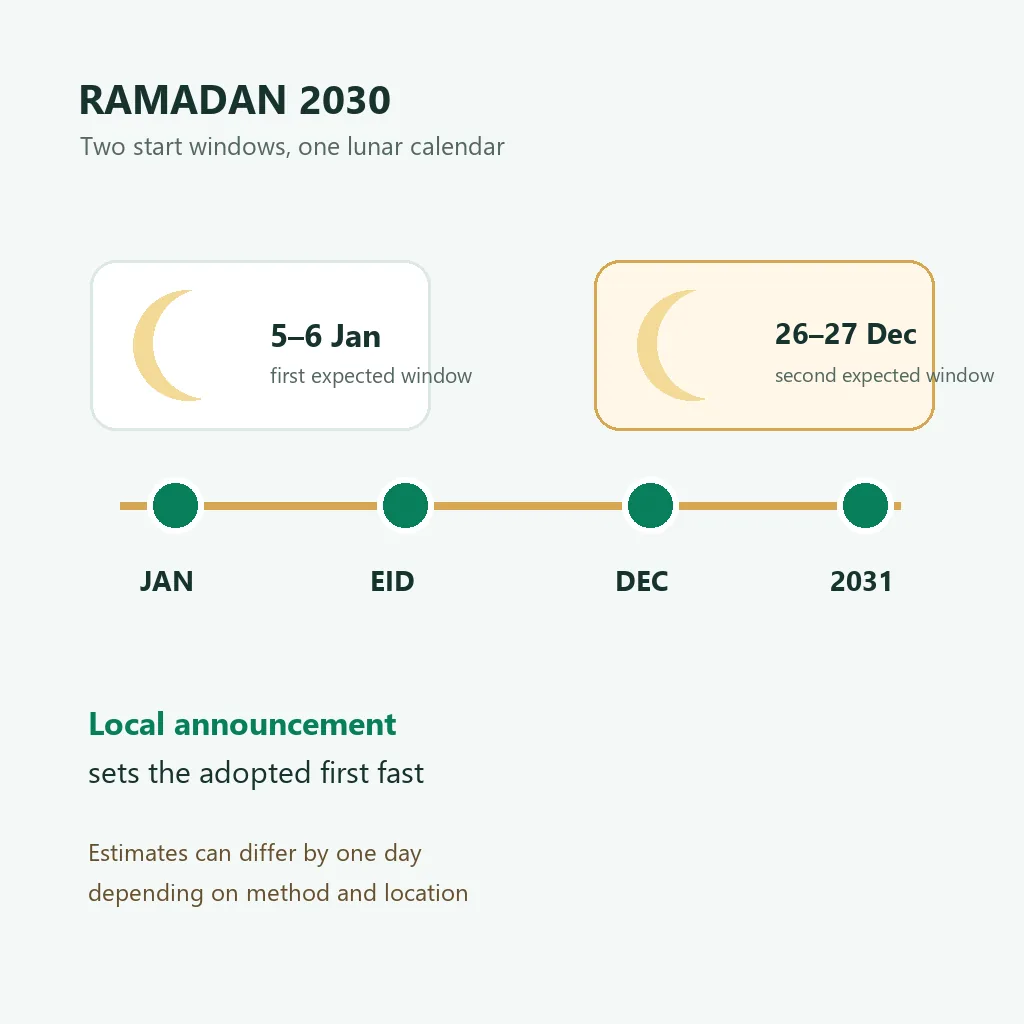
Ramadan 2030 is expected to appear twice within the Gregorian year: the first Ramadan 1451 window is commonly placed around January 5–6, and another Ramadan start is expected around December 26–27. These are advance calendar estimates, not one worldwide final announcement. Moon-sighting practice, calculation methods and local authorities can move the adopted date by a day. This guide separates the two windows and shows how to verify the date that applies where you live.
Quick answer: when is Ramadan 2030?
For early planning, many calculated calendars place the first day of Ramadan 1451 around Saturday, January 5, 2030, while some location-based calendars show Sunday, January 6. The difference is a reminder that a future Ramadan date is a window until the authority followed by your country or community confirms it. The first Ramadan in this Gregorian year is the month that runs through January and into early February.
Expected Ramadan 2030 and Ramadan 1451 dates
The table keeps the two Gregorian-year windows separate. The January window is Ramadan 1451 AH; the late-December start begins the next Ramadan month, usually labelled Ramadan 1452 AH. A calendar estimate helps with preparation, but the adopted first fast follows the local method and announcement.
| Stage | Approximate timing | What it means | What to do |
|---|---|---|---|
| First Ramadan 1451 window | January 5–6, 2030 | Common calculated calendars place the first fasting day at the beginning of January. | Save a one-day planning range and note the country or community. |
| First Eid al-Fitr window | February 4–5, 2030 | Ramadan may last 29 or 30 days, so the end can fall on adjacent dates. | Keep leave, travel and visits flexible until Shawwal is confirmed. |
| Second Ramadan start | December 26–27, 2030 | The lunar cycle brings another Ramadan beginning before the Gregorian year ends. | Label it as the next Ramadan and check whether your source uses 1452 AH. |
| Second Ramadan continuation | January 2031 | The late-December month continues into the following Gregorian year. | Do not count it as a second complete Ramadan inside 2030. |
| Final local confirmation | After the announcement | The relevant authority sets the date used by the local community or institution. | Replace the estimate and save the Hijri and Gregorian forms together. |
A one-day difference can result from calculation, visibility criteria, time zone or local announcement. For worship, public holidays and formal commitments, follow the competent authority in your location.
Why can Ramadan begin twice in the Gregorian year 2030?
The Islamic calendar is lunar, so Ramadan moves through the Gregorian seasons by roughly ten or eleven days each year. Eventually a Gregorian year begins with one Ramadan and ends with the start of another. In 2030, the January month is the first window and the late-December start belongs to the next Hijri year. The pattern is a calendar relationship, not a claim that two complete fasting months fit inside twelve Gregorian months.
The exact adopted day still depends on the calendar or moon-sighting authority followed by the reader.
What is the difference between the Ramadan night and the first fasting day?
Islamic dates begin at sunset, while a fasting day usually means daylight from local dawn to sunset. One source may therefore describe the Ramadan beginning on the evening of January 4 or 5, while another lists the first fast on January 5 or 6. Both can describe different parts of the same transition, including the December start.
When searching for Ramadan 2030, check whether the result names the conjunction, observation evening, first dawn of fasting, final day or Eid al-Fitr. For meals, travel, work and school, save the event with its location and time zone; a bare Gregorian date is easy to misread when two lunar months appear in one year.
- Save the expected evening and first fasting day as separate calendar events.
- Use dawn and sunset times for your location rather than a generic city.
- Set a reminder before each window to check the local announcement.
- Keep the Hijri year, Gregorian date, country and source in the event note.
How to plan for Ramadan 2030 without treating an estimate as final
Two Ramadan starts make labels important. Keep the estimated window, event type and source together so you can update the date without confusing January with late December.
1. Start with a date range
Use January 5–6, 2030 for the first window and December 26–27 for the second. This gives you a useful reminder without presenting one date as universal. Keep the adjacent day open for the local decision.
2. Name the event
Choose the observation evening, first fasting dawn, final Ramadan day or Eid al-Fitr. They are separate events, and the label prevents a work plan or booking from treating a night date as the first daylight fast.
3. Add the Hijri year
Write Ramadan 1451 for January and Ramadan 1452 for late December when your source uses that numbering. Both calendars make copied notes easier to check and reduce confusion with Ramadan 2029.
4. Record source and time zone
Save the calendar or authority, country, city or time zone and checking date. This context helps when people compare calendars with different calculation settings.
How to verify the local Ramadan 2030 announcement
Begin with the authority that sets worship dates or public holidays for your country or community. Depending on where you live, this may be a ministry, a recognised religious council, an official calendar or a mosque network. Annual prediction pages are useful for orientation, but the local announcement is the source to use when the first fast or Eid date must be settled.
- Confirm whether the page means Ramadan 1451 or Ramadan 1452.
- Separate an estimated date from an official local decision.
- Check the country, city and time zone when travel is involved.
- Save the Hijri and Gregorian dates together with the event label.
- Review the source again before fixing leave, travel or a formal schedule.
Accuracy and limits of Ramadan 2030 dates
A Hijri month can have 29 or 30 days, and communities may use calculation, visibility criteria, testimony or an institutional announcement. Time zones can also change how a universal date appears locally. The January and December ranges are planning estimates, not a worldwide notice.
This guide explains the calendar pattern and a verification method; it is not a religious ruling. Use the ranges to prepare, then follow the local authority for the first fast, Eid al-Fitr, a holiday or a fixed appointment.
Related tools and guides
Frequently asked questions about Ramadan 2030
When does Ramadan 2030 start?
Advance calendars place the first Ramadan 1451 fast around January 5 or 6, 2030, and another start around December 26 or 27. The adopted day can differ locally by one day.
Will there be two Ramadans in 2030?
There can be two Ramadan beginnings in the Gregorian year, in early January and late December. The December month continues into 2031, so 2030 does not contain two complete lunar months.
What is Ramadan 1451 in the Gregorian calendar?
Ramadan 1451 should fall mainly in January and early February 2030. Common calendars show the first fast around January 5–6 and Eid al-Fitr around February 4–5.
When is the first Eid al-Fitr in 2030?
Advance calendars show a first Eid al-Fitr window around February 4 or 5, depending on a 29- or 30-day Ramadan and the local method. Confirm Shawwal locally.
Is the Ramadan night the day before the first fast?
The Islamic night begins after sunset, so the observation evening may be described as the evening before the first daylight fast. Check whether the source names the night, dawn or civil date.
References for comparison and verification
These references help compare calculated calendars and explain why a future date can differ by a day. Use the local authority for the adopted fasting and Eid date:
Summary
Ramadan 2030 is expected to begin around January 5–6 and again around December 26–27, with the first month corresponding to Ramadan 1451 and the late-December start belonging to the next Hijri year. Use the windows for early planning, distinguish the preceding night from the first fast, and confirm every important date with the local authority.