Annual guide updated September 13, 2026
Islamic Calendar 2028: Gregorian Months, Hijri Dates and Key Events
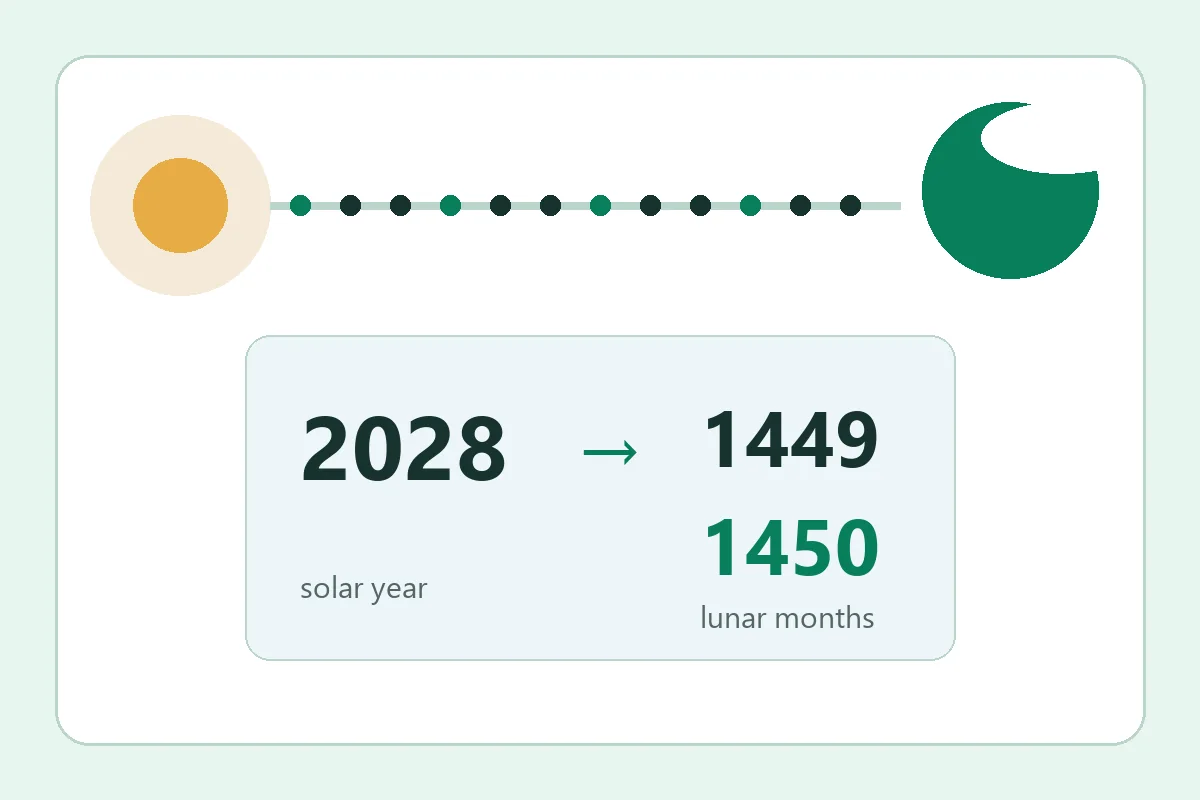
The Islamic calendar 2028 crosses Hijri years 1449 and 1450. The Gregorian year begins near the end of Sha'ban 1449, moves through Ramadan and the two Eids, and reaches Muharram 1450 around late May. This guide brings the month-by-month map, major events, and a practical way to check the final local date.
Quick answer: what does the 2028 calendar cover?
Gregorian 2028 begins in late Sha'ban 1449, reaches Ramadan near the end of January, and places Eid al-Fitr in late February. After Shawwal, Dhu al-Qi'dah and Dhu al-Hijjah continue through spring; Muharram 1450 begins around May 25 in many calculated tables. In other words, an Islamic calendar 2028 is a bridge between 1449 and 1450, not one complete Hijri year.
The ranges on this page are useful for early planning and for understanding the sequence of months. For the first fast, Eid, Hajj, a public holiday, or an official document, check the calendar adopted by the relevant country or institution. A moon-sighting or local announcement can move a date by one day. For a specific day, use a Hijri/Gregorian converter rather than relying on a month name alone.
Islamic calendar 2028 month-by-month table
The table pairs Gregorian months with approximate Hijri ranges. Event dates follow commonly published calculated calendars available at the update date; they are not a universal announcement for every country.
| Gregorian month in 2028 | Approximate Hijri range | Planning note |
|---|---|---|
| January | Sha'ban and Ramadan 1449 | The year opens near the end of Sha'ban; Ramadan is often placed around January 28 or 29. |
| February | Ramadan and Shawwal 1449 | Ramadan continues before Eid al-Fitr, often around February 27 or 28; wait for the local Shawwal announcement. |
| March | Shawwal and Dhu al-Qi'dah 1449 | Useful for reviewing travel, work and family dates recorded during Ramadan or Shawwal. |
| April | Dhu al-Qi'dah and Dhu al-Hijjah 1449 | Dhu al-Hijjah approaches in spring, so leave flexibility for Arafah, Eid and Hajj-related planning. |
| May | Dhu al-Hijjah 1449 and Muharram 1450 | Arafah and Eid al-Adha are often placed near May 4 and 5, followed by Muharram 1450 around May 25. |
| June | Muharram and Safar 1450 | Ashura is often shown near June 3 or 4; the date should follow the reference used by your community. |
| July | Safar and Rabi' al-Awwal 1450 | Keep the Hijri year number beside the month when saving a summer appointment or reminder. |
| August | Rabi' al-Awwal and Rabi' al-Thani 1450 | Calculated calendars often place Mawlid near August 3, but local practice can differ. |
| September | Rabi' al-Thani and Jumada al-Awwal 1450 | Write both calendar forms when a long-term booking or travel document may be checked later. |
| October | Jumada al-Awwal and Jumada al-Thani 1450 | A good month for comparing conversions, but a general table is not a government holiday notice. |
| November | Jumada al-Thani and Rajab 1450 | Hijri months move through the seasons; do not assume the same month always falls in the same weather. |
| December | Rajab and Sha'ban 1450 | The Gregorian year ends inside 1450; Ramadan 1450 belongs near the beginning of 2029, not December 2028. |
A lunar month can begin one day earlier or later depending on the calculation, sighting and official reference. Use this table for sequence and planning, then confirm the final date.
How does 2028 move between Hijri 1449 and 1450?
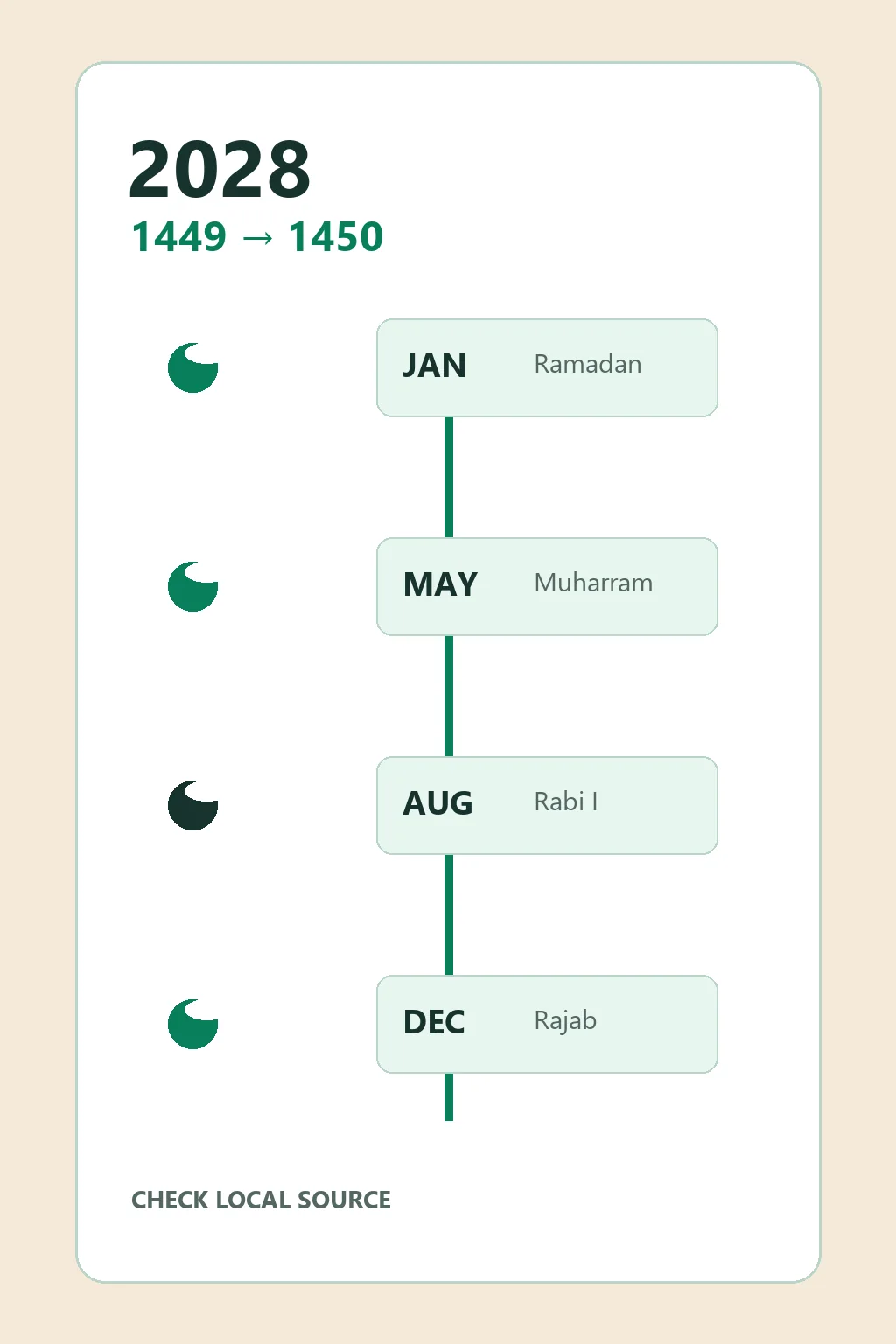
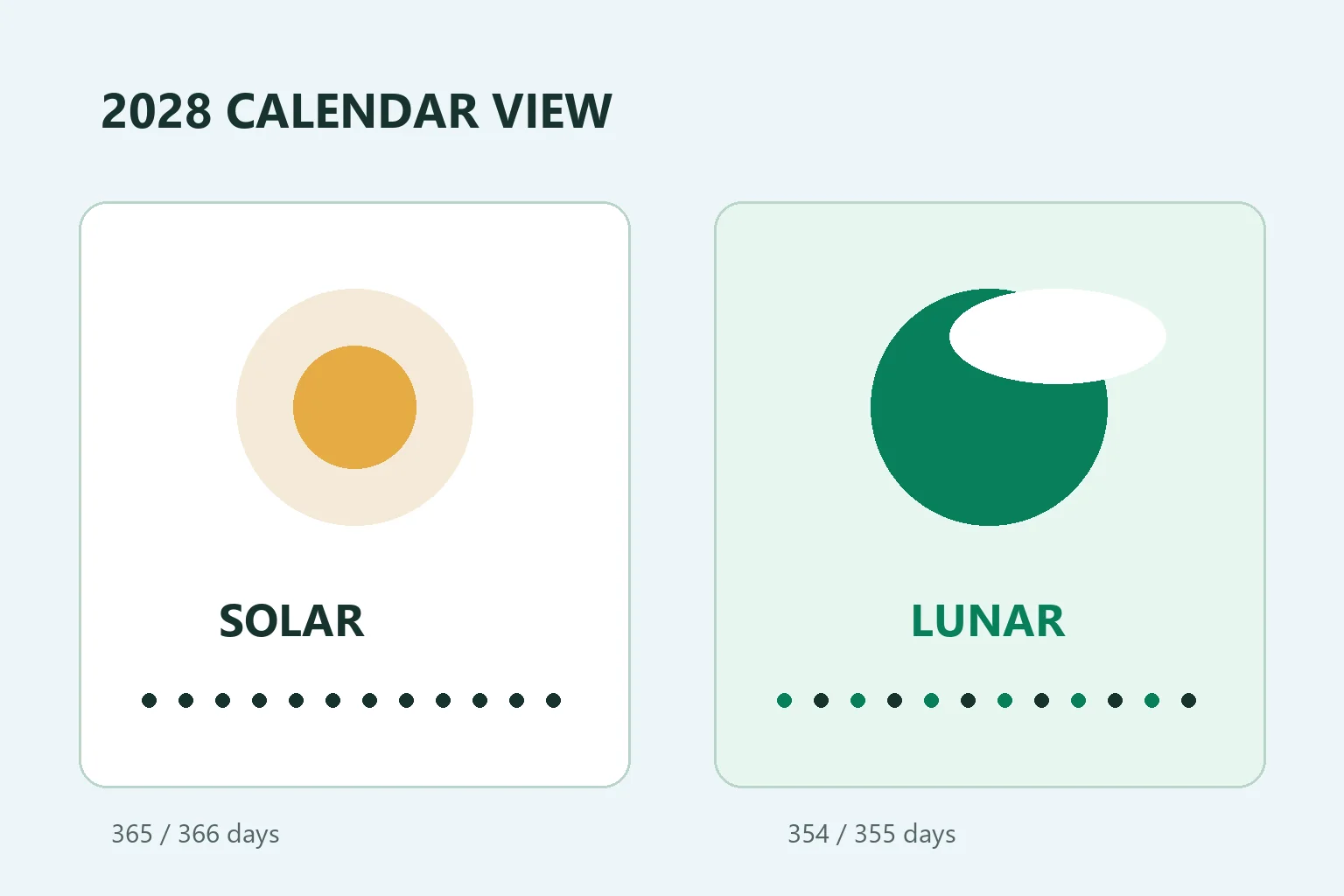
The Gregorian year follows the solar cycle and normally has 365 days, or 366 in a leap year. A Hijri year follows twelve lunar months and has about 354 or 355 days. Because the lunar year is shorter, Hijri months arrive roughly ten or eleven days earlier in the Gregorian calendar each year. That is why one Gregorian year can contain meaningful parts of two Hijri years.
- Start of the year
January connects Sha'ban with Ramadan 1449, and the calculated start of Ramadan may differ from the local announcement by a day. - Ramadan and Eid
Ramadan and Shawwal occupy most of January and February, making fasting and Eid dates the most visible early-year questions. - The changeover
Dhu al-Hijjah 1449 ends and Muharram 1450 begins near May 25 in many calculated calendars. - End of the year
The months of 1450 continue from summer into December; Ramadan 1450 is expected in 2029, after this Gregorian year ends.
Movement between seasons is a normal result of the shorter lunar year, not an error in the calendar.
Ramadan, the Eids and important events in 2028
- Ramadan 1449
Calculated calendars often place the first day of Ramadan around January 28 or 29, 2028. The first fast depends on the accepted local method and announcement. - Eid al-Fitr 1449
The first of Shawwal follows Ramadan and is often shown around February 27 or 28, 2028. Check the official date before fixing travel or leave. - Arafah and Eid al-Adha 1449
Arafah and Eid al-Adha are commonly placed near May 4 and 5, 2028. Hajj and public-holiday schedules require an official source. - Hijri New Year 1450
Muharram 1450 is expected near May 25, 2028, in many calculated calendars. This estimate is not a universal government announcement. - Ashura and Mawlid
Ashura is often shown near June 3 or 4, and Mawlid near August 3. Confirm the day with the calendar or institution you follow.
How to use the Islamic calendar 2028 for planning
Start by deciding how much precision you need. A month range is enough to understand when Ramadan falls or how the year flows. A flight, contract, school break, holiday, fast, Eid visit, or official form needs the complete day, country, time zone, and calendar reference that will be accepted when sources differ.
- Write the Hijri year beside the month; Ramadan or Rajab without a year can be ambiguous.
- Convert a complete day with the Hijri/Gregorian converter instead of turning a month range into a fixed date.
- Leave one or two flexible days for travel and appointments arranged months ahead.
- Record the country, time zone and calendar reference, especially when traveling between countries.
- Update the reminder after the official announcement and note why a one-day difference appeared.
A practical way to convert a 2028 Gregorian date to Hijri
A useful conversion is one you can review later. Follow these steps when you need the Hijri equivalent of a specific Gregorian date in 2028.
1. Write the complete day
Choose the Gregorian day, month and year. “Ramadan 2028” describes a period, not one exact day.
2. Open a date converter
Enter the date in a Hijri/Gregorian converter and note the calendar method or setting if one is shown.
3. Read month and year together
Check the month and year, such as Ramadan 1449 or Muharram 1450; the year is especially important near late May.
4. Compare a local source
For Ramadan, Eid, Hajj or public holidays, compare the result with a government, religious or institutional calendar for the country.
5. Save the confirmed version
Keep both forms, the country and the check date, then update the reminder if the local announcement differs by one day.
Which source should you use when dates differ?
| Source | What it provides | When to use it |
|---|---|---|
| Annual calculated table | Approximate month and season mapping | Understanding 2028's relationship with 1449 and 1450 and planning early. |
| Hijri/Gregorian converter | A complete day-level conversion | A specific appointment, historical date or initial comparison. |
| Official calendar | A country or institution's adopted rule | Government holidays, school dates and formal paperwork. |
| Local sighting or announcement | Confirmation of a month or observance | The first fast, Eid and dates that cannot rely on an estimate. |
Accuracy and limits of the Islamic calendar 2028
A future Hijri month does not always have one universally accepted Gregorian start date. Some calendars use astronomical calculations or a fixed civil rule. Some countries and communities connect the start of a month to moon sighting or a formal announcement. This is why the page uses ranges and words such as “expected” when a date is still in the future.
A one-day difference does not make the annual table useless: it still explains the season and month sequence. It does mean that the source must match the decision. This guide is informational, not a religious ruling, government notice or guarantee that every country will observe a holiday on the same day.
For worship, Hajj, holidays and official documents, follow the competent local authority and use a converter to record the final day in both calendar systems.
Related tools and guides
Frequently asked questions about the Islamic calendar 2028
Which Hijri years are included in the Gregorian calendar 2028?
Gregorian 2028 starts near the end of Sha'ban 1449 and moves into Muharram 1450 around late May. It is not one complete Hijri year.
When does Ramadan 1449 start in 2028?
Calculated calendars often place the first day around January 28 or 29, 2028. The first fast follows the method and announcement accepted by the local community.
When is Eid al-Fitr in 2028?
Eid al-Fitr follows Ramadan 1449 and is often shown around February 27 or 28, 2028. Check the official local date before fixing leave or travel.
When does Hijri year 1450 begin?
Many calculated tables place Muharram 1450 near May 25, 2028, but the day can change by country, calendar method or sighting practice.
References for comparison
These references can help compare an annual calculated table with a local calendar and understand why a month may begin on a different day:
Summary
The Gregorian year 2028 begins near the end of Hijri 1449 and enters 1450 around late May. Use the month table for the overview, the converter for a complete day, and the official local source for Ramadan, Eid, Hajj, holidays and formal dates.